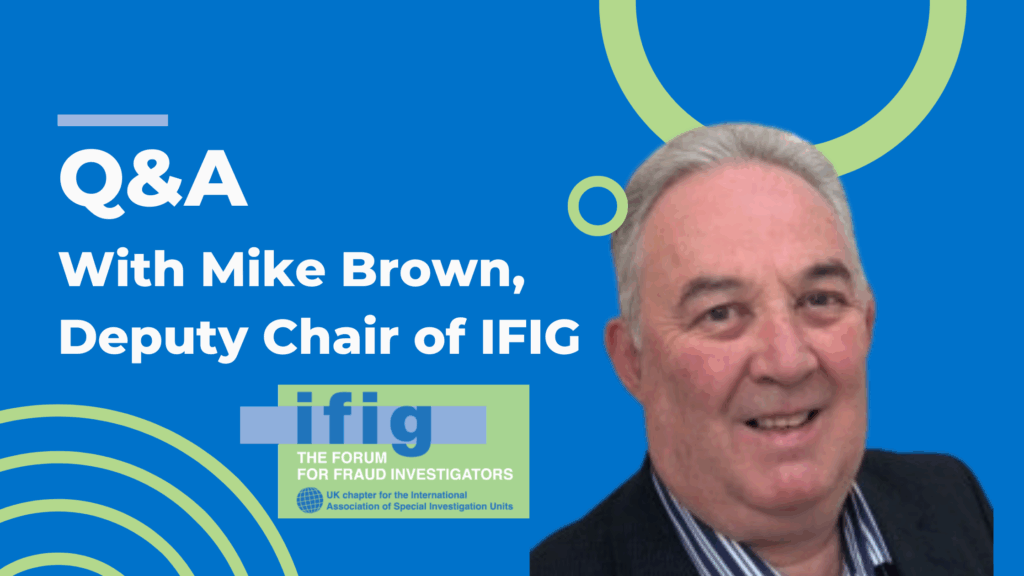
Introducing Our Deputy Chair: A Deep Dive into Mike’s Extraordinary Fraud Career
This month, we’re proud to shine a spotlight on Mike Brown, IFIG’s Deputy Chair and Intelligence Platform Lead; a figure widely respected across law enforcement, insurance, regulation, and intelligence for over four decades.
From investigating organised crime cheque book frauds in the 1970s, to earning a Judge’s Commendation for complex financial investigations, to leading one of the UK’s top covert intelligence bureaus, Mike’s career has shaped not only his own approach to intelligence-led fraud prevention but has influenced national standards and modern counter-fraud practice.
Across policing, the Solicitors Regulation Authority, Direct Line Group, and now Weightmans LLP, Mike has devoted his career to strengthening fraud intelligence, driving innovation, and mentoring the next generation of professionals.
In this special Q&A, Mike shares his remarkable journey, the evolution of intelligence-led fraud prevention, his priorities for IFIG, and the mindset needed to thrive in such a dynamic and demanding field.
His insights reflect not just deep expertise, but genuine passion for protecting industries, organisations, and individuals from fraud, and we’re delighted to share more of his story with our members.
 Can you tell us a bit about your journey into fraud investigation and intelligence, and what drew you to this field?
 I will try to keep it brief. My fraud journey began in the mid-1970s during my initial CID attachment, where I worked on a case involving notorious cheque book frauds committed by organised crime groups. That experience sparked a lifelong passion for fraud investigation, which followed me into my role as a Traffic Patrol Officer. There, I prosecuted drivers for false documentation, insurance certificates, MOTs, registrations, driving licences, and investigated false insurance claims (yes, insurance fraud was rampant in the ’70s and ’80s).
I later qualified as a Detective, and my first major fraud case involved an emerging tech company in the North East, Technical Solutions Ltd. At the time, technology was just beginning to take off, and the fraudster exploited that opportunity. They were convicted at Oxford Crown Court and sentenced to imprisonment. I was honoured to receive a Judge’s Commendation for my detailed approach and case delivery on such a complex matter.
My ability to research, investigate, and secure intelligence led me to complete an advanced intelligence course and support the National Crime Intelligence Service (NCIS) in delivering the National Intelligence Model (NIM) across the UK in 2002. I also qualified as an advanced covert operative, managing and handling covert intelligence sources.
At the height of my policing career, I led the establishment of a dedicated covert intelligence bureau, which underwent rigorous annual audits by the Surveillance Commissioner. By the time I retired, the bureau had earned recognition as one of the top two in UK policing.
Intelligence and fraud go hand in glove, and I was involved in numerous fraud cases throughout my policing career, many of which are best shared over a drink!
Upon retiring from the police in 2007, I joined the Solicitors Regulation Authority (SRA), heading up their Fraud and Confidential Intelligence Bureau. My focus was on identifying and investigating fraud within the legal profession. During this time, I also completed a master’s degree (MA) in Fraud Management.
In 2011, I was appointed Head of Fraud Intelligence at Direct Line Group (formerly RBSI), where I developed a leading counter fraud function. Over 11.5 years, the department became renowned for its success in tackling fraud through an intelligence led approach. The core skills I developed in policing and at the SRA were instrumental in building one of the most successful teams I’ve had the pleasure to lead.
In 2022, I transitioned into my current role as National Head of Fraud at Weightmans LLP, a challenging and rewarding position that reconnects me with all my past experience and allows me to support the firm’s clients with confidence and insight.
My story continues, and there are plenty more tales to tell. I am honoured to be part of IFIG’s journey in tackling fraud.
You’ve held leadership roles across law enforcement, insurance, and legal regulation; how have these experiences shaped your approach to intelligence-led fraud prevention?
My cross-sector experience has been instrumental in shaping a holistic, intelligence led approach to fraud prevention. In law enforcement, I learned the value of proactive intelligence gathering and the importance of disrupting criminal networks before harm occurs. That instilled in me a mindset of prevention over reaction.
In the insurance sector, I gained a deep appreciation for the scale and complexity of fraud risk in commercial environments. I saw firsthand how data, when properly harnessed, can reveal patterns of abuse and inform smarter underwriting and claims decisions. It also taught me the importance of balancing risk mitigation with customer experience.
Finally, my time in legal regulation reinforced the need for strong governance, ethical frameworks, and cross industry collaboration. Fraud doesn’t respect organisational boundaries, so neither can our response. I’ve become a strong advocate for integrated intelligence combining behavioural analytics, inter-agency data sharing, and human insight to stay ahead of evolving threats.
Together, these experiences have shaped a strategic, data-driven, and collaborative approach to fraud prevention one that’s agile enough to adapt to emerging risks while grounded in the principles of fairness and accountability.
As Deputy Chair and Intel Platform Lead at IFIG, what do you see as the most important focus areas for the board in the coming year?
As Deputy Chair and Intelligence Platform Lead at IFIG, I see three key focus areas for the board in the coming year:
1. Enhancing cross sector intelligence collaboration: Fraud is increasingly borderless, both geographically and across industries. Strengthening our data-sharing frameworks and fostering deeper collaboration between public and private sectors will be essential to staying ahead of emerging threats.
2. Driving innovation in analytics and technology: We must continue to evolve our intelligence capabilities by investing in advanced analytics, machine learning, and real time data integration. This will enable faster detection, smarter risk profiling, and more agile responses to fraud typologies that are becoming more sophisticated by the day.
3. Embedding ethical governance and trust: As we expand our intelligence capabilities, we must ensure that transparency, accountability, and proportionality remain at the heart of our approach. Building public trust in how intelligence is used is just as important as the insights themselves.
Ultimately, our role as a board is to set the strategic tone and ensure IFIG remains a trusted, forward-looking leader in the fight against fraud. That means being bold in our vision, but grounded in collaboration and integrity.
What do you think is the most common misconception about fraud intelligence work, and how do you challenge it?
One of the most common misconceptions about fraud intelligence work is that it’s purely reactive focused on chasing fraud after it happens. In reality, the most effective fraud intelligence is proactive, predictive, and strategic.
People often assume it’s just about data crunching or flagging suspicious transactions. But true intelligence led fraud prevention is about understanding behaviours, identifying emerging threats, and disrupting fraud before it manifests. It’s as much about psychology and pattern recognition as it is about technology.
I challenge this misconception by advocating for intelligence to be embedded at the heart of decision making not just in investigations, but in policy design, customer journeys, and risk frameworks. I also emphasise the human element: collaboration across sectors, sharing insights, and building trust are just as critical as the algorithms we deploy.
Ultimately, fraud intelligence isn’t just a tool it’s a mindset. And shifting that perception is key to building more resilient systems.
For professionals aspiring to a career in fraud intelligence, what skills or mindset do you think are essential?
For professionals aspiring to a career in fraud intelligence, I’d say curiosity and integrity are just as important as technical skill. Fraud intelligence isn’t just about spotting anomalies it’s about understanding human behaviour, anticipating risk, and thinking like both a strategist and a detective.
Key skills include:
- Analytical thinking: The ability to interpret complex data, spot patterns, and connect seemingly unrelated dots.
- Communication: Translating intelligence into actionable insights for diverse stakeholders from investigators to executives.
- Tech fluency: Comfort with data platforms, analytics tools, and emerging technologies like machine learning is increasingly vital.
- Collaboration: Fraud does not operate in silos, and neither should we. Cross sector teamwork and information sharing are essential.
Mindset wise:
- Be relentlessly curious. Ask why, dig deeper, and challenge assumptions.
- Stay agile. Fraud evolves quickly, so must you’re thinking.
- Lead with integrity. Intelligence work carries ethical weight; trust is earned through responsible action.
Fraud intelligence is a dynamic, purpose driven field. If you are motivated by impact and thrive on solving complex problems, it is an incredibly rewarding path.
Outside of your professional life, how do you switch off from the intensity of fraud investigations and intelligence work?
Switching off from the intensity of fraud investigations and intelligence work is essential not just for balance, but for clarity. For me, it is about finding spaces where complexity gives way to simplicity.
I live in a rural area, and I spend time outdoors whenever I can with my family and walking with ‘Luna’ my Sprocker Spaniel, or just being in nature. There is something grounding about fresh air and open skies that helps reset the mind. I also enjoy reading, particularly history and psychology, which offer perspective and remind me that patterns of behaviour, fraud included are part of a much bigger human story. Then there’s music, whether it’s listening, or attending live performances, music has a way of cutting through noise and reconnecting me with emotion and creativity. Ultimately, I have learned that switching off is not about escape, it is about renewal. It’s what allows me to return to the work with sharper focus and a steadier hand.